
 Ariocarpus.org
Ariocarpus trigonus
(F.A.C.Weber) K.Schum. · Bot. Jahrb. Syst. 24: 550 (1898) · basionym Anhalonium trigonum F.A.C.Weber (1893) · living rock cactus
| Family | Cactaceae |
| Genus | Ariocarpus |
| Species | A. trigonus |
| Authority | (F.A.C.Weber) K.Schum. |
| Range | NE Mexico: Nuevo León & Tamaulipas |
| Elevation | ~500–1200 m, on limestone scree |
| Flowers | pale yellow to cream, 3–5 cm across |
Run your finger along an Ariocarpus trigonus and the difference is obvious before you ever see a flower. The tubercles are long, narrow, and erect, often curling inward like fingers half-closing into a fist. Among the living rocks, this is the lanky one.
Most members of the genus hug the ground in tight, flat rosettes. Ariocarpus trigonus breaks that mold. Its triangular tubercles stand up and stretch out, roughly twice as long as they are wide, giving the whole plant a taller, looser, more reaching look than its squat relatives.
Our companion site keeps a cultivation-focused Ariocarpus trigonus profile for growers.
There is a naming wrinkle worth flagging up front. POWO accepts Ariocarpus trigonus as a full species. The living-rocks treatment, following Anderson & Fitz Maurice (1997), instead sinks it as A. retusus subsp. trigonus. Same plant, two ranks. We follow POWO and treat it as a species, but you will meet both names in the literature.
What it looks like
The tubercles are the whole story here. They run 3 to 8 cm long and 1 to 2.5 cm broad, usually about twice as long as wide. They are triangular in cross-section, acute at the tips, and they point outward and upward rather than lying flat.
Unlike the crowded, basally compressed tubercles of A. retusus, those of trigonus are divergent and not crowded, with room between them. They are also strongly incurved, bending back toward the center of the plant. That elongate, erect, incurved habit is what gives the species its sprawling, almost shaggy silhouette.
Flowers and fruit
Here is the single cleanest tell. The flowers of Ariocarpus trigonus are pale yellow to cream, in both the outer and inner perianth segments. Its close relatives lean white or, more rarely, magenta, so a yellow flower on a long-tubercled plant is about as diagnostic as it gets in this genus.
Blooms measure 3 to 5 cm across and 2.5 to 4 cm long. The fruit that follows is whitish or greenish, 7 to 20 mm long and 5 to 10 mm in diameter, ripening down among the tubercles where the wool collects.
Where it grows
Ariocarpus trigonus is native to northeastern Mexico, in the states of Nuevo León and Tamaulipas. It follows the eastern slopes of the Sierra Madre Oriental, running from north of Monterrey, between Montemorelos and Linares, and down the Jaumave Valley to south of Jaumave.
That is a stretch of more than 400 kilometers of suitable ground. The plants sit on limestone scree at lower elevations than many of their relatives, roughly 500 to 1200 m. The low limestone habitat is part of why this species reads as the lowland, warm-slope member of the group.
Telling it apart
The usual confusion is with Ariocarpus retusus. Look at the tubercles first. On retusus they are broad and short, nearly as broad as long, crowded together and compressed at the base. On trigonus they are elongate triangles, about twice as long as wide, divergent and not crowded.
Then check the flower. A. retusus flowers white, occasionally with reddish midribs, and only rarely magenta. A. trigonus flowers yellow to cream. Tall narrow tubercles plus a yellow bloom is the trigonus combination, and neither half alone is quite enough to be sure.
Forms recorded within it
A handful of names sit under Ariocarpus trigonus. Most are POWO synonyms, and the first card below is really the rank question itself, since the living-rocks treatment files this whole plant as a subspecies of retusus. The full synonymy is laid out at our varieties page.
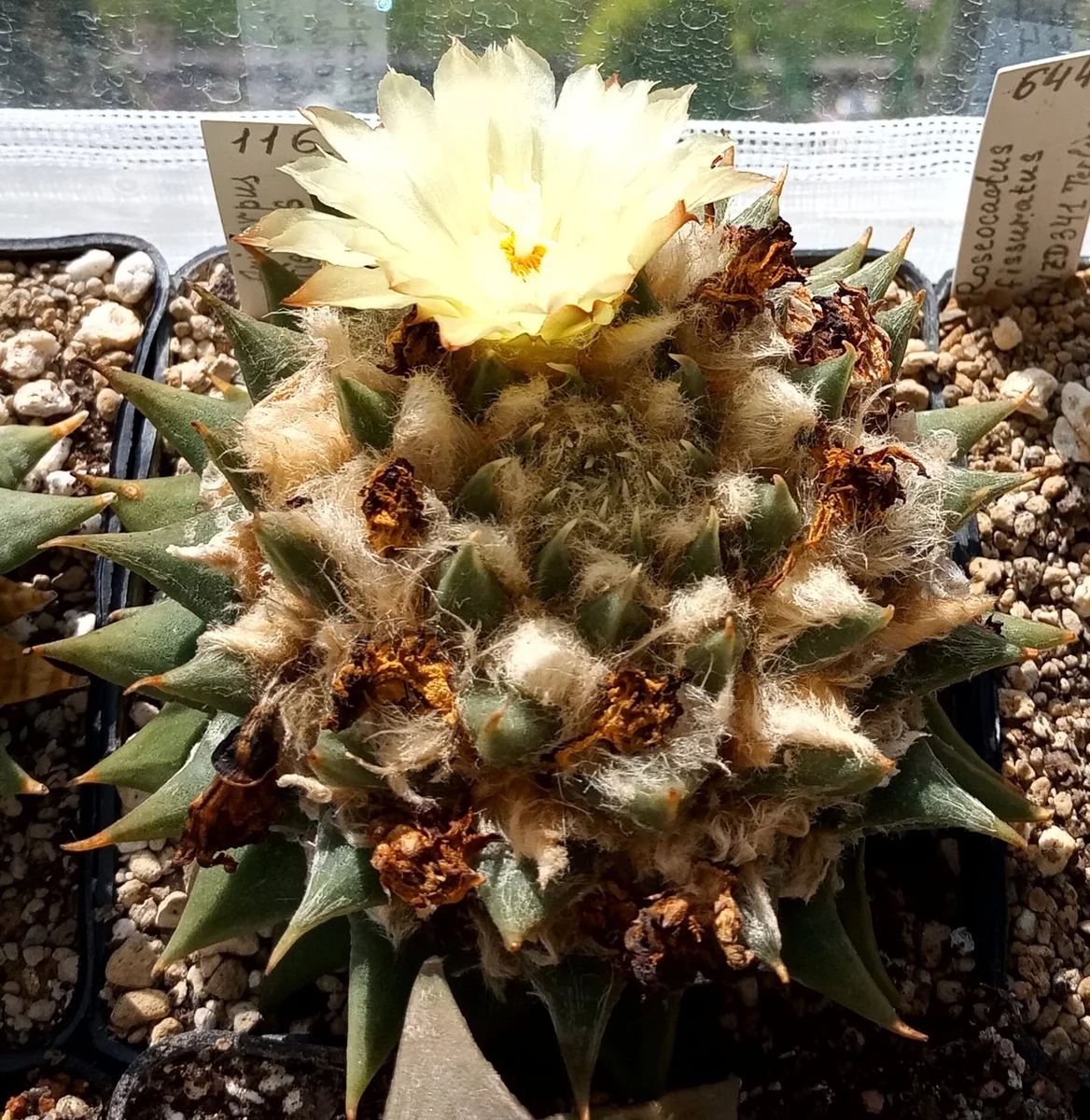
A. retusus subsp. trigonus
the trigonus plantSynonymThe competing rank itself. This is the living-rocks treatment, following Anderson & Fitz Maurice (1997), which sinks trigonus as a subspecies of A. retusus. POWO instead accepts it as a full species, and we follow POWO.
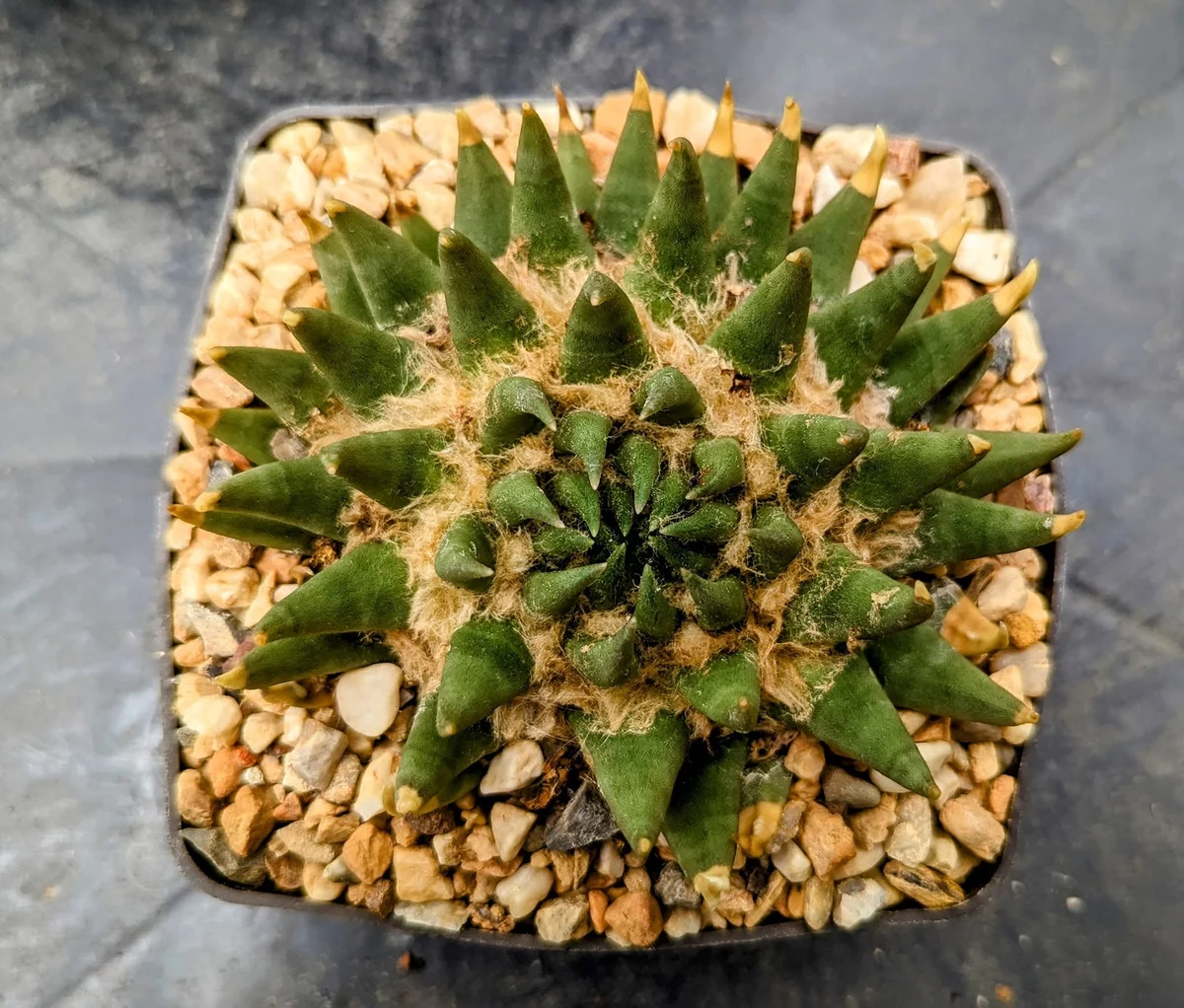
A. trigonus var. elongatus
long-tubercled formSynonymA named variant emphasizing the already long tubercles of the species. POWO treats it as a synonym, as it does Batov’s f. elongatissimus, the same idea pushed to the most extreme long-tubercled plants.
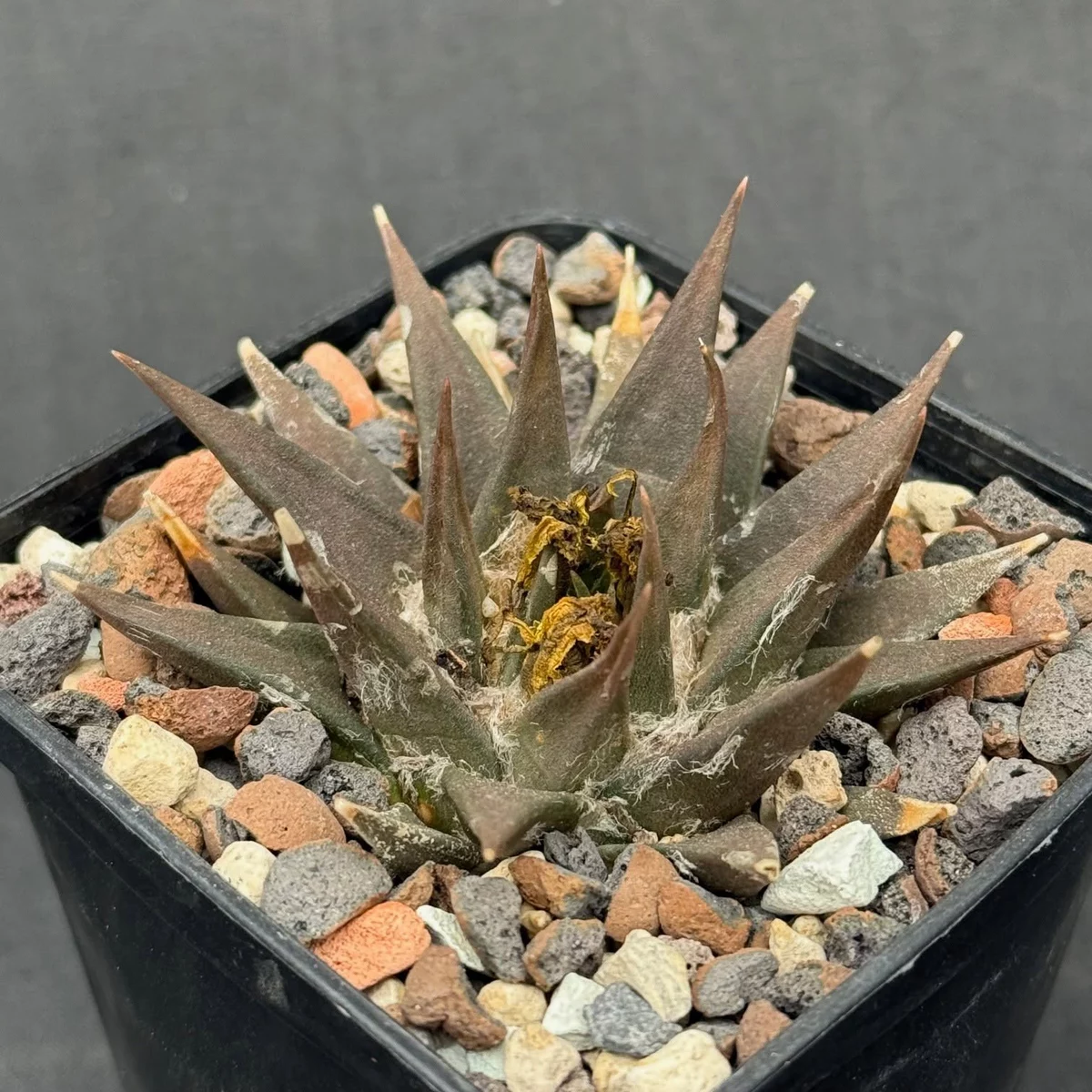
A. trigonus f. minor
the small formSynonymA smaller-statured form, based on Voldan’s earlier var. minor (1976). A POWO synonym.
Grow one yourself
Seed-grown Ariocarpus trigonus, raised in cultivation rather than dug from the wild, are available from our companion shop.
Shop seed-grown AriocarpusSources
- Plants of the World Online (POWO), Royal Botanic Gardens, Kew: Ariocarpus trigonus (F.A.C.Weber) K.Schum. powo.science.kew.org
- Living Rocks of Mexico (living-rocks.com): Ariocarpus trigonus account living-rocks.com
- Living Rocks of Mexico (living-rocks.com): Ariocarpus retusus account (comparison) living-rocks.com