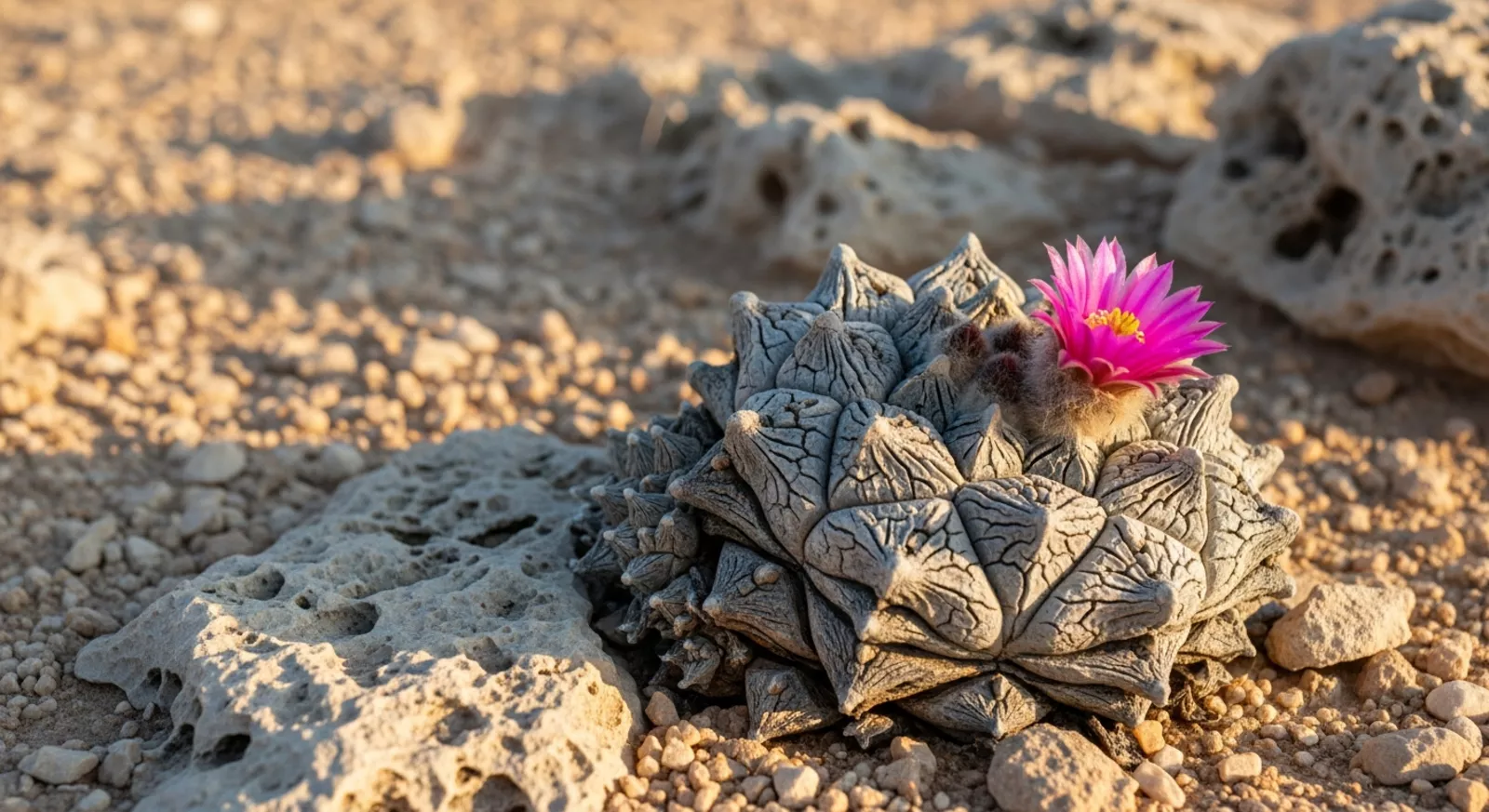
 Ariocarpus.org
Ariocarpus agavioides
(Castañeda) E.S.Anderson · Amer. J. Bot. 49: 615 (1962) · Basionym: Neogomesia agavioides Castañeda (1941) · Agave living rock
| Family | Cactaceae |
| Genus | Ariocarpus |
| Species | A. agavioides |
| Authority | (Castañeda) E.S.Anderson |
| Range | Mexico: Tamaulipas to San Luis Potosí |
| Elevation | about 1200 m |
| Flowers | Magenta, 3.5–4.2 cm across |
Most living rocks hug the ground in broad, blunt wedges. Not this one. Ariocarpus agavioides throws out long, skinny, finger-like tubercles that splay across the soil like a tiny green agave. Once described as its own genus, it stayed the oddball of the group.
Castañeda found the plant near Tula in Tamaulipas and, in 1941, decided it was strange enough to need a brand-new genus of its own. He called it Neogomesia agavioides. The agave reference was the whole point, since nothing else in the cactus world looked quite like it.
Two decades later, in 1962, E.S.Anderson moved it into Ariocarpus, where it has stayed ever since. The genus Neogomesia is gone now, folded away as a synonym, but you can still see why Castañeda thought it deserved special treatment. Among the living rocks, agavioides is the one that breaks the mold.
If you want to grow the agave mimic, our companion site has an Ariocarpus agavoides grow guide.
What it looks like
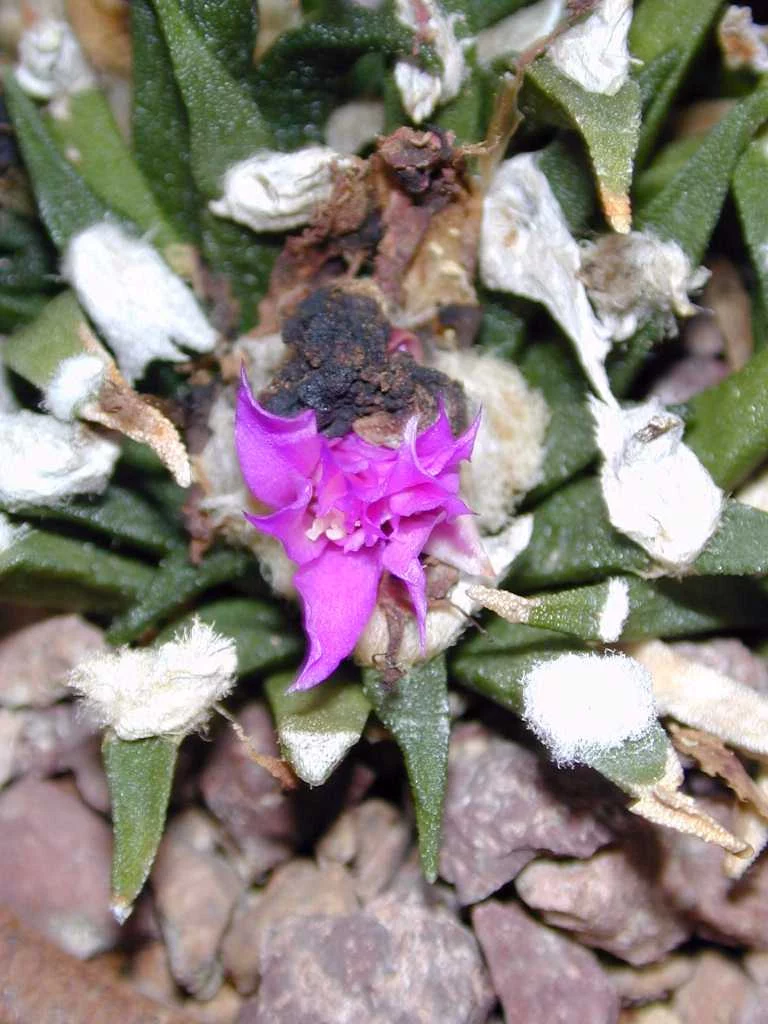
The body sits barely above ground, sub-globose and flattened on top, usually 2 to 6 cm high and 4 to 8 cm across. It is a quiet greenish-brown, the kind of color that vanishes against dry soil. Most of the year that is exactly the point.
The tubercles are the giveaway. They are long, narrow, and slender, 3 to 7 cm long but only 5 to 10 mm broad, which makes each one more than four times as long as it is wide. They spread outward, often a little floppy rather than stiffly upright, and the overall effect really does read as a small agave pressed flat to the earth. Spines are absent or, very rarely, you get one or two short whitish ones only a few millimeters long.
Flowers and fruit
For such a small plant the flowers are big and loud. They open 3.5 to 4.2 cm across, with outer petals magenta edged in greenish-white and inner petals a deep, saturated magenta. The white style runs 1 to 2 cm long and carries five to eight short stigma lobes.
The fruit follows as a pinkish-red to reddish-purple berry, globose to elongate, roughly 10 to 20 mm long and 5 to 12 mm wide. Against the muted body, both the bloom and the fruit are a sudden flash of color.
Where it grows
The native range runs from Tamaulipas down into San Luis Potosí, in northeastern Mexico. The classic locality is around the town of Tula in Tamaulipas, where the plant turns up on rocky limestone hills and out on flat alluvial plains at roughly 1200 m.
It is a rare and localized cactus, tied to specific low, dry sites. The seed-grown route is the sensible way to own one.
Telling it apart
This is the easy one. Every other Ariocarpus builds its rosette from broad, triangular tubercles packed into a tight star. A. agavioides does the opposite, with long, thin, finger-like tubercles that splay out loosely. If the tubercles look more like agave leaves than like flat triangles, you are looking at agavioides, and you can call it from across the bench.
The magenta flowers and the low, ground-level body fit the genus, but the slender tubercles alone are enough. No other species in the group shares that shape.
Forms recorded within it
Ariocarpus agavioides is monotypic: POWO recognizes no subspecies or varieties. The names you will meet on old labels, including its original genus name Neogomesia and later subspecies and forms, are all synonyms. The full synonymy is laid out at /varieties/.
Ariocarpus agavioides
one species, no subspeciesAccepted speciesPOWO accepts no subspecies or varieties, so the species stands on its own. Its original name Neogomesia agavioides Castañeda (1941), and later names like subsp. sanluisensis and subsp. pulcher, are all treated as synonyms.
Grow one yourself
Seed-grown Ariocarpus agavioides, raised in cultivation rather than dug from the wild, are available from our companion shop.
Shop seed-grown living rock cactiSources
- Plants of the World Online (POWO), Royal Botanic Gardens, Kew: Ariocarpus agavioides (Castañeda) E.S.Anderson powo.science.kew.org
- Living Rocks of Mexico: Ariocarpus agavoides species account living-rocks.com
- Specimen photograph: Kaktalia, public domain, via Wikimedia Commons commons.wikimedia.org
