 Ariocarpus.org
Ariocarpus bravoanus
H.M.Hern. & E.F.Anderson · Bradleya 10: 1 (1992) · Bravo’s living rock cactus
| Family | Cactaceae |
| Genus | Ariocarpus |
| Species | A. bravoanus |
| Authority | H.M.Hern. & E.F.Anderson |
| Range | Mexico (San Luis Potosí) |
| Elevation | around 1500 m |
| Flowers | cream outer segments, pinkish-magenta inner, about 2.5 cm long |
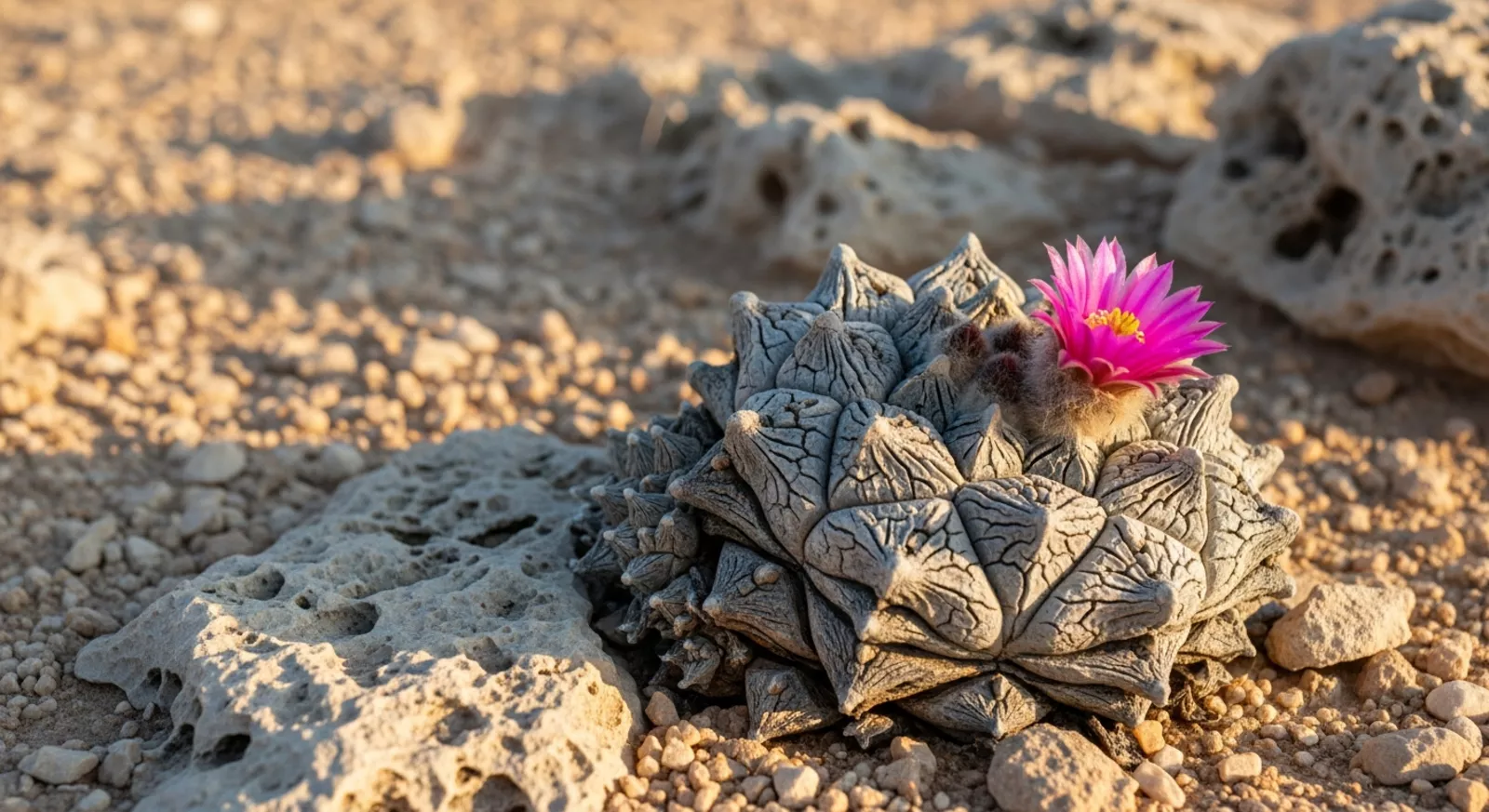
Here’s a cactus that botanists only named in 1992, which is recent as these things go. Ariocarpus bravoanus hides in a tiny stretch of San Luis Potosí, its woolly crown pressed flat against a limestone gravel plain. Miss the magenta flowers and you’d walk right past it.
Ariocarpus bravoanus is a small, slow plant that stays mostly buried, with just the top couple of centimeters of its tubercled body showing above the soil. The stem is simple and subglobose, roughly 6 to 8.5 cm across but rising only 2.5 to 3.5 cm above ground. H.M. Hernández and E.F. Anderson described it in Bradleya in 1992, making it one of the more recent additions to the genus.
POWO accepts two subspecies: the type, subsp. bravoanus, and subsp. hintonii, the small plant from near Matehuala. Together they are the only accepted infraspecific taxa in the whole genus, so this is the one Ariocarpus where the subspecies rank actually holds up.
For notes on keeping it in cultivation, see our companion guide to caring for Ariocarpus bravoanus.
What it looks like
The body is subglobose and almost always solitary. Tubercles are triangular and deltate in cross section, growing more concave and ascending as the plant matures. They reach 3 to 7 cm long and about 2 cm wide at the base, tapering to sharply acute or acuminate tips with hard edges.
The crown carries the wool that gives the genus its character. Areoles are rounded to roughly elliptic, 2 to 5 mm across, and covered in wool. New growth pushes up through that woolly center, which is also where the flowers appear.
Flowers and fruit
Flowers are about 2.5 cm long. The outer segments are cream colored, while the inner segments are a pinkish magenta, the bright note that makes a flowering plant easy to spot against the gravel. White filaments carry yellow anthers, and the pistil stands above them.
Seeds are small, roughly 1 to 1.5 mm long and 0.7 to 1.5 mm wide, black, and pyriform to sacciform in shape.
Where it grows
Ariocarpus bravoanus is native to Mexico, specifically northern San Luis Potosí in the northeast of the country. Its range is extremely limited, which is part of why it stayed unnamed for so long.
The type subspecies sits at around 1500 m on a limestone gravel plain among creosote bush. Subsp. hintonii grows south of Matehuala, also in San Luis Potosí. POWO places the species in the desert and dry shrubland biome.
Telling it apart
Against A. fissuratus, the body of A. bravoanus reads differently: its tubercles are longer, more clearly triangular, and ascending rather than the flat, fissured, flush-to-the-ground tubercle surface that defines fissuratus. The magenta inner segments also separate it from the more muted fissuratus bloom.
A. kotschoubeyanus is a smaller, flatter plant with a distinct groove running down each tubercle, a feature A. bravoanus lacks. Note that older treatments shuffled bravoanus around, sinking it under both fissuratus and kotschoubeyanus as a subspecies; POWO treats those as synonyms and keeps bravoanus as its own species.
Forms recorded within it
A. bravoanus is the only species in the genus with accepted subspecies, and POWO recognizes exactly two: the nominate subsp. bravoanus and subsp. hintonii, both shown below. Older names such as A. fissuratus subsp. bravoanus are treated as synonyms; the full synonymy lives at /varieties/.
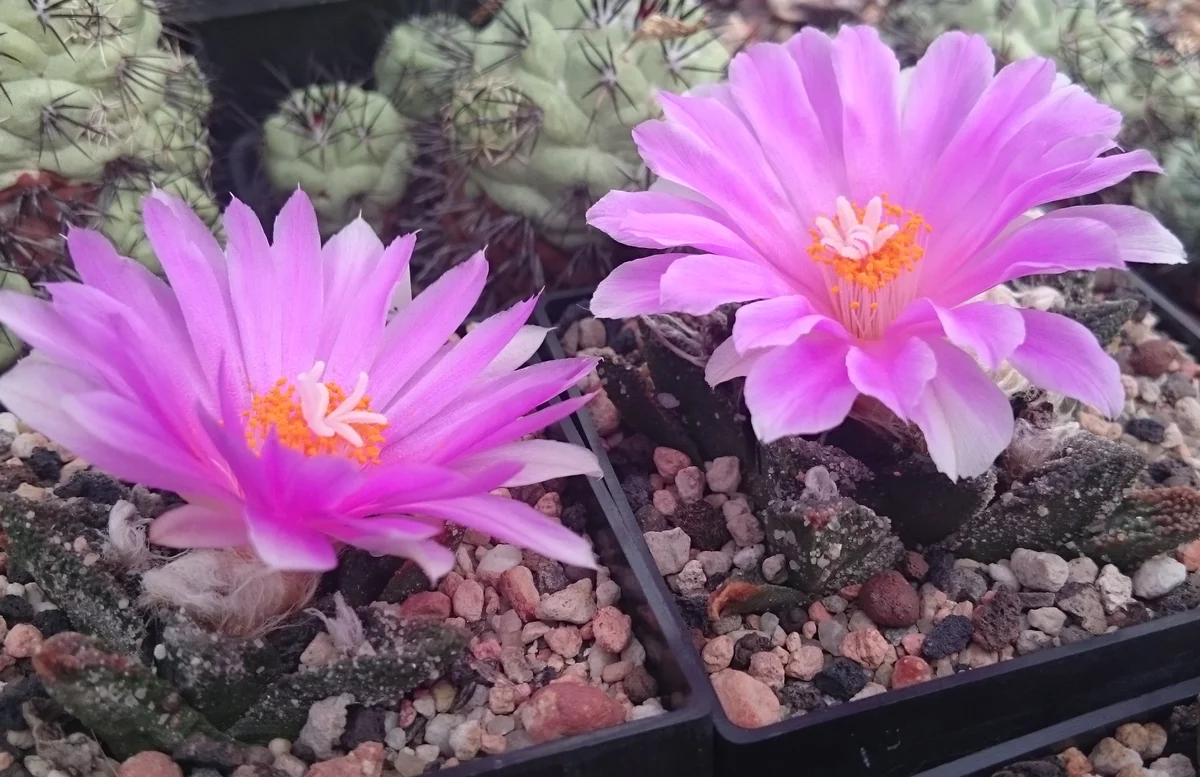
A. bravoanus subsp. bravoanus
the nominate, type formAcceptedThe nominate subspecies and the type of the species, from a limestone gravel plain in northern San Luis Potosí at around 1500 m. This is the plant most growers mean when they simply say A. bravoanus.
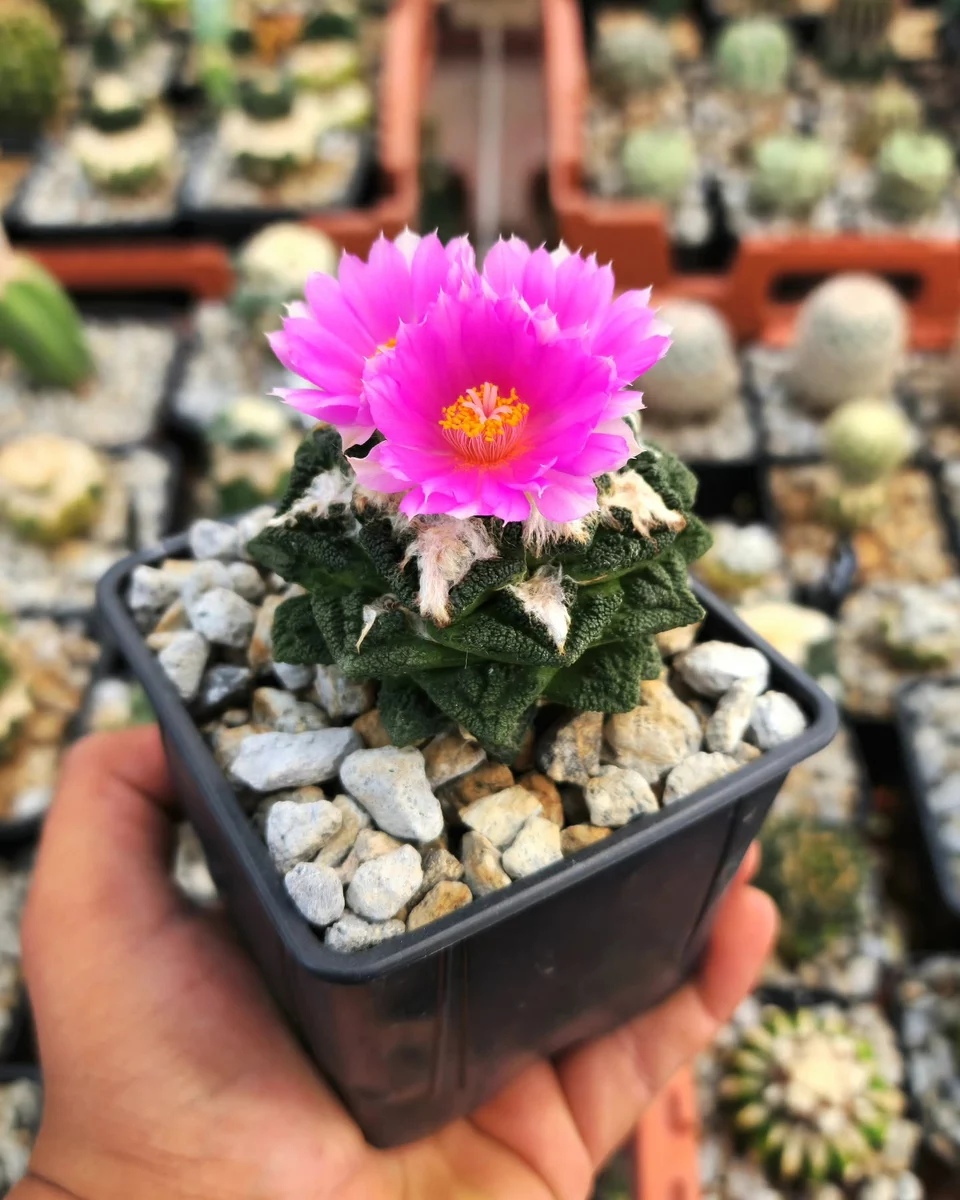
A. bravoanus subsp. hintonii
SB 1568 · near MatehualaAcceptedThe other accepted subspecies, a smaller plant from south of Matehuala in San Luis Potosí, widely grown under the field number SB 1568. Its basionym was authored by Stuppy & N.P.Taylor before E.F.Anderson & W.A.Fitz Maurice transferred it under bravoanus.
Grow one yourself
Seed-grown Ariocarpus bravoanus, raised in cultivation rather than dug from the wild, are available from our companion shop.
Browse our seed-grown AriocarpusSources
- Plants of the World Online (POWO), Royal Botanic Gardens, Kew: Ariocarpus bravoanus H.M.Hern. & E.F.Anderson powo.science.kew.org
- Living Rocks of Mexico (living-rocks.com): Ariocarpus bravoanus species account and habitat data living-rocks.com
- Specimen photograph: Michael Wolf, CC BY-SA 3.0, via Wikimedia Commons commons.wikimedia.org
