 Ariocarpus.org
Ariocarpus scaphirostrus
Boed. · Monatsschr. Deutsch. Kakteen-Ges. 2: 60 (1930) · Nuevo León living rock
| Family | Cactaceae |
| Genus | Ariocarpus |
| Species | A. scaphirostrus |
| Authority | Boed. |
| Range | Mexico: Nuevo León, valley of Rayones near Monterrey |
| Elevation | 950–1400 m |
| Flowers | Magenta, 3–4 cm, autumn |
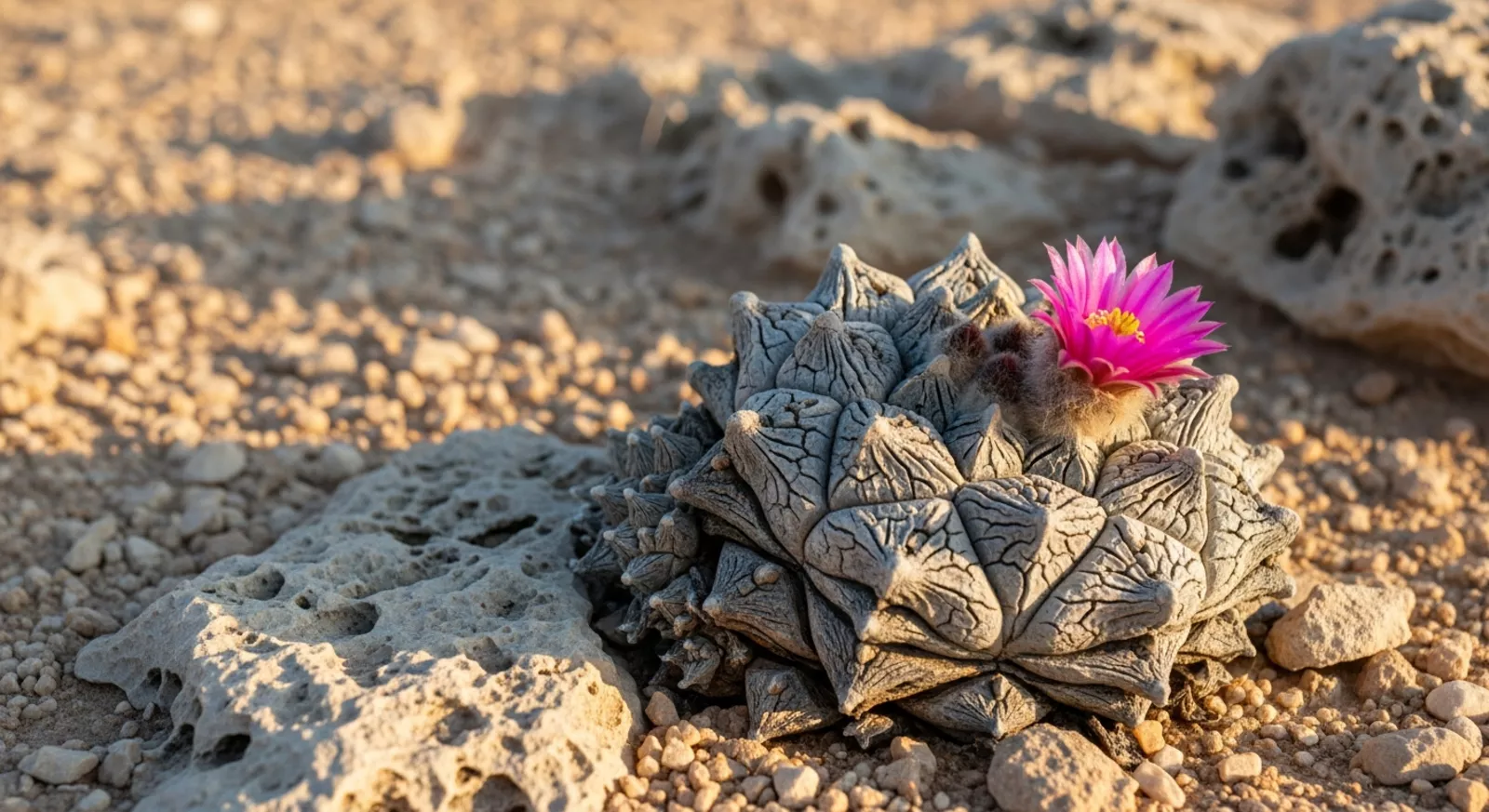
Picture a fistful of thick, boat-shaped beaks crowded into a low rosette, and you have Ariocarpus scaphirostrus. It hides in clay on a few arid limestone hills near Rayones, in Nuevo León. Among the rarest and most local of all the living rock cacti, it earns its name from those keeled, scaphoid tubercles.
The plant sits barely above the soil, gray-green and globose, roughly 3 to 7 cm across and 2 to 6 cm tall. Most of the time it is tucked flush with the ground, which makes it almost invisible until something is blooming.
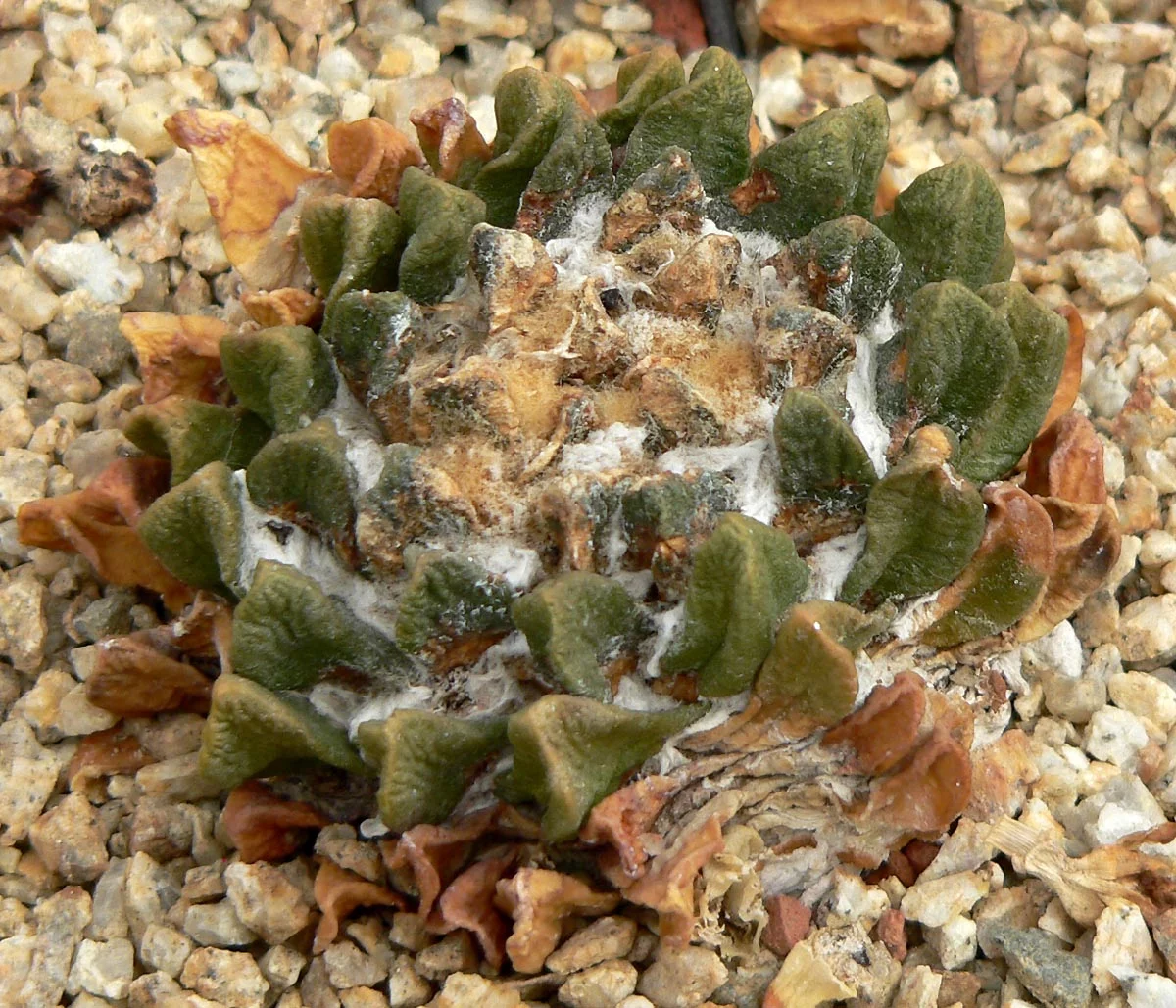
What gives it away are the tubercles. They stand erect and divergent, bluntly pointed, smooth and flattened on the upper face, at least twice as long as they are wide. Each one runs about 2 to 4 cm long and only 5 to 8 mm broad, slightly incurved, with a keel underneath that reads like a little chin. Gray wool fills the grooves between them. There are no spines.
Our companion site covers cultivation in its Ariocarpus scaphirostris care guide.
A body built from boat-shaped beaks
The whole look of this species comes down to those thick, keeled tubercles. Where most of its relatives spread flat, papery, triangular tubercles against the ground, A. scaphirostrus pushes up narrow, three-dimensional ones with a boat-like profile and a ridged keel along the underside. That keel is the chin-like feature the species is famous for.
The name scaphirostrus comes from the Latin scapha, meaning boat, paired with a word for beak. Put together it describes a boat-shaped beak, which is exactly what each tubercle resembles. A woolly groove runs down the upper surface of each tubercle, and more gray wool packs the spaces between them, the spot where flowers eventually emerge.
Flowers and fruit
The flowers are magenta, a bright dark purple-pink, and reach up to about 3 to 4 cm across. They open by day and the plant is self-fertile, so a single specimen can set seed on its own.
Flowering comes late. This is frequently the last species in the whole genus to bloom, opening in autumn, and when it goes it flowers and fruits freely. The fruit is greenish, small, roughly 9 to 15 mm long and 4 to 8 mm in diameter, the same understated shape the rest of Ariocarpus tend to produce.
Where it grows
This is a Nuevo León endemic, and a tightly local one. It is known from the valley of Rayones, with populations tied to a single valley across a handful of hillsides, in the broad region near Monterrey. El Barreal is one recorded site.
The ground is harsh: extremely arid, low limestone hills with clayey soils. Plants grow between roughly 950 and 1400 m of elevation. Because the whole range sits in one valley, it is one of the most restricted and genuinely rare members of the genus.
Telling it apart
The quickest way to separate A. scaphirostrus from its relatives is the tubercle shape. Its tubercles are thick, narrow, and boat-shaped, with a keel underneath, while the flatter-tubercled species in the genus lay broad, smooth, triangular tubercles flat against the soil.
Add the proportions and it gets easier still. Each tubercle is at least twice as long as it is broad, spineless, with a woolly groove on top and gray wool packed around the base. No other Ariocarpus stacks up that particular combination of keeled, scaphoid, finger-like tubercles.
Forms recorded within it
Ariocarpus scaphirostrus is monotypic: POWO recognizes no subspecies or varieties. The one named variety, var. swobodae, is treated as a synonym, and the common spelling scaphirostris is just an orthographic variant of the same plant. Full synonymy lives at /varieties/.
Ariocarpus scaphirostrus
one species, no subspeciesAccepted speciesPOWO accepts no subspecies or varieties, so the species stands on its own. The one named variety, var. swobodae (Halda, Horáček & Panar., 1998), is treated as a synonym, and the frequent spelling scaphirostris is just an orthographic variant of the same name.
Grow one yourself
Seed-grown Ariocarpus scaphirostrus, raised in cultivation rather than dug from the wild, are available from our companion shop.
Browse seed-grown Ariocarpus specimensSources
- Plants of the World Online (POWO), Kew: Ariocarpus scaphirostrus Boed. powo.science.kew.org
- Living Rocks of Mexico: Ariocarpus scaphirostrus species account living-rocks.com
- Llifle Encyclopedia of Cacti: Ariocarpus scaphirostris llifle.com
- Specimen photograph: Stan Shebs, CC BY-SA 3.0, via Wikimedia Commons commons.wikimedia.org
